




Rewrite this local event or lifestyle story to be enticing for North Carolina residents. Keep HTML tags:
Character Studies is an INDY series about familiar faces around the Triangle—and the stories you may not know about them.
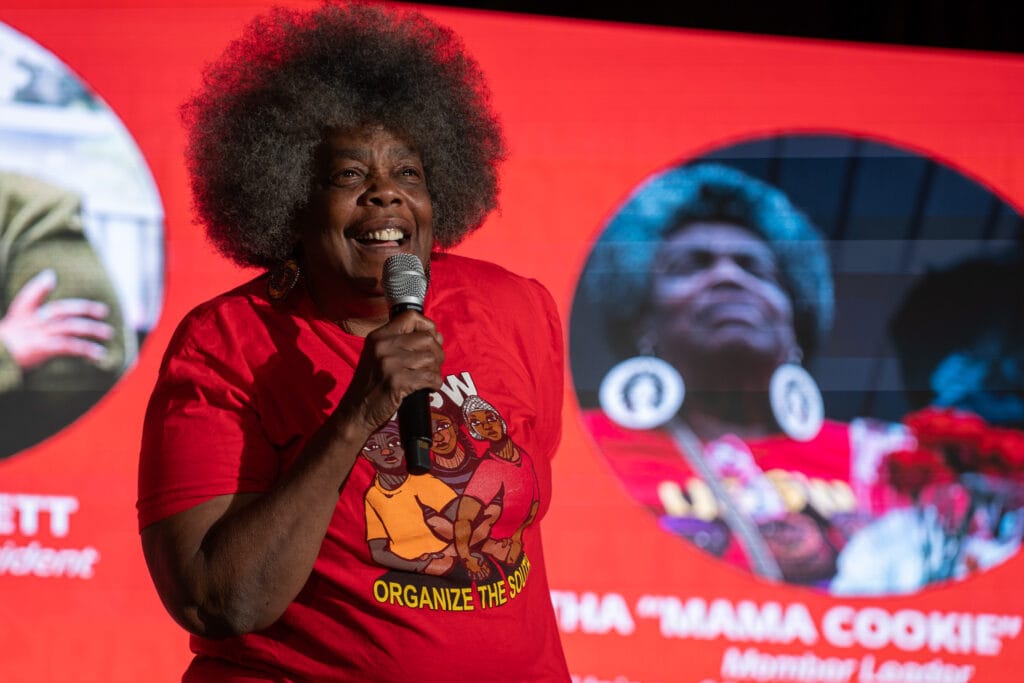
Bertha Bradley is one of Durham’s leading activists, yet very few people know her name—but only because no one calls her by it. When she was little, her grandmother called her “Cookie.” The nickname stuck like glue.
Cookie, a lifelong Durham resident, has been instrumental in movements like Fight for $15 and a Union and the Union of Southern Service Workers, both of which strive to improve working conditions for service-industry workers in the South. Her passion about this subject comes from firsthand experience.
While raising her, Cookie’s grandparents imbued her with values that still serve as her moral compass. Not least was the importance of hard work. “It didn’t matter where you worked,” Cookie said. “It was how much you put into it.”
Her grandfather worked at Duke Power—even when it was dangerous to get to and from work. During the unrest stirred up by Martin Luther King Jr.’s 1968 assassination, he needed a pass just to leave the house.
Her grandmother’s job at Turnage’s Barbecue was equally instructive. Working hard was important, but so was fighting to make sure that work was justly rewarded.
“I used to watch her work so hard with no health insurance or benefits,” said Cookie. “I realized that my grandma was suffering, going to work with her legs wrapped up because she couldn’t afford a doctor, and that she shouldn’t have been suffering.”
Before her family moved to Durham’s West End, Cookie’s early life revolved around Fayetteville Street: Fayetteville Elementary, the Whitted School, the barbershop. Before long, she discovered a painful reality: No matter how smart and driven they were, she and her siblings wouldn’t be going to college. There was no way her grandparents could afford to send one kid there, much less eight.
When she was 14, she got a summer job at Pappy’s Pizza in Northgate Mall, and she didn’t stop working for the next 50 years.
Cookie’s next job involved deboning chickens at the Central Carolina Farmers Exchange on Gilbert Street. When her grandmother got sick, Cookie got a job at Jareh Healthcare, so she could learn how to take care of her.
Cookie’s grandmother once discouraged her, she recalled, from complaining about the inequities their family faced: “Cookie, you don’t need to get involved in that.”
“Let that girl alone,” she remembered her grandfather responding. “Let her fight. One day she’s going to make us proud. She’s not going to stand down and not open her mouth.”
It was a pivotal moment for Cookie. “That’s why I do what I do,” she said. “Because of my grandpa. He didn’t allow me not to be heard.”
Cookie joined the Communist Workers Party when she was 19. “That’s when I learned that I have a voice, that I have rights,” she said. “Listening to their…


