




Rewrite this local event or lifestyle story to be enticing for North Carolina residents. Keep HTML tags:
This story originally published in The 9th Street Journal.
Inside a concrete bay at Durham’s Waste Disposal and Recycling Center on East Club Boulevard, a plastic water bottle lands with a dull crack against a pile of cardboard and glass, quickly swallowed into a growing heap of mixed material.
Within minutes, a front-end loader scoops it up and drops it into a steel trailer that will be hauled to a sorting facility in Raleigh. If the bottle is clean and correctly sorted, it may be shredded, melted and turned into fiber for clothing or carpeting.
For many residents, that process goes on unseen, fueling a persistent doubt: Does recycling actually work, or is it all getting thrown away?
The confusion starts with a lack of understanding of how Durham handles its waste.
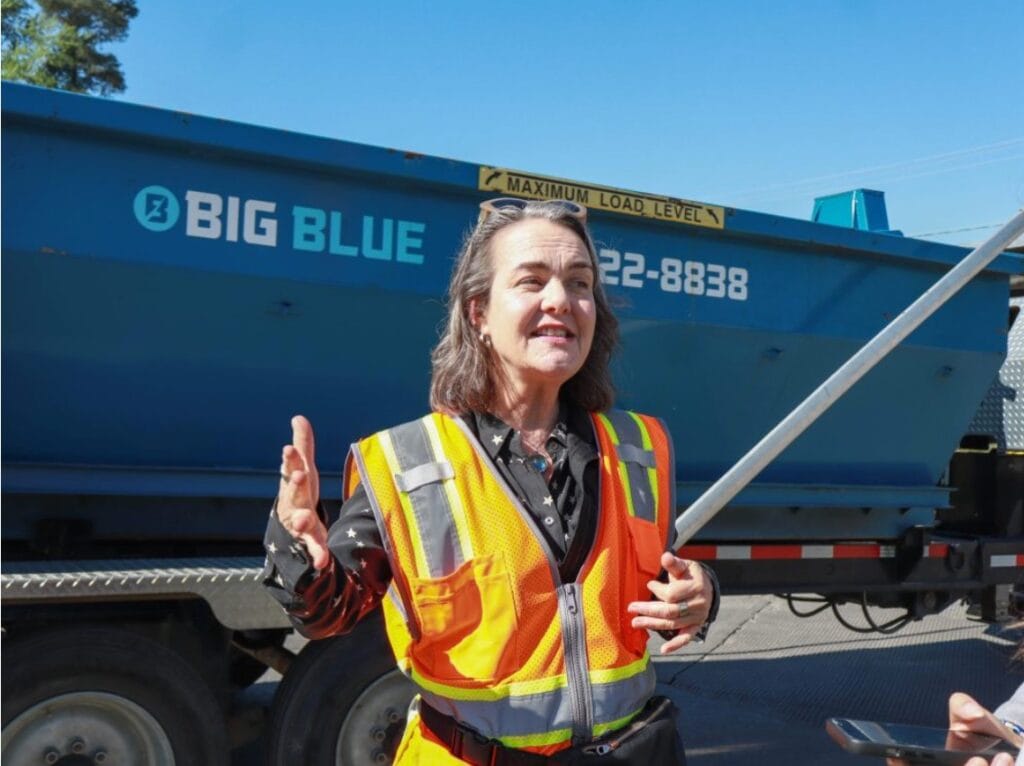
“Some people still think that there’s a landfill in Durham,” said Muriel Williman, 57, senior assistant solid waste manager for disposal. “There isn’t.”
Durham’s landfill closed in 1994, and the city has not landfilled its waste locally since then. Instead, it operates a transfer system in which both trash and recycling are collected curbside, brought to the Club Boulevard facility and loaded into larger trailers for transport. Trash is sent to a landfill in Sampson County, while recycling is sent to a materials recovery facility in Raleigh, where it is sorted and sold.

A single recycling truck may stop at 750 to 1,000 Durham homes on a typical route before returning to the waste center. At the transfer station, those smaller loads are combined into larger trailers that can carry up to 26 tons of material, with multiple shipments leaving the site each day for processing facilities outside Durham.
At the Raleigh facility, the sorting process is both mechanical and manual. Materials are spread across conveyor belts and separated by type: magnets pull out steel cans, electrical currents separate aluminum and optical scanners identify plastics. Workers along the line remove contamination by hand. By the end of the process, the materials are compressed into bales—cardboard, paper, metal and plastics—and sold to manufacturers.
“Recycling is not small,” Williman said. “It is a huge industry, and it employs 15,000 people in the private sector.”
But the system depends entirely on what residents put into their blue carts, and that is where it often breaks down.
A common issue is “wish cycling,” the practice of putting items into recycling in the hope that they will be sorted out later. In reality, items that do not belong are pulled off the line and discarded, often after traveling through the system at additional cost.
“The thing is, if they have to sort it out and discard it, guess what?…


